Showing posts with label burnout. Show all posts

Thursday, April 24, 2014

South Korea Ferry Disaster

When the unimaginable happens, it is common to ask "Why?" "What if?" "What next?"

Watching the media repeatedly air stories about incredible disasters and accidents, it is understandable that after about a week of constant exposure to the never ending details of these stories that people begin to feel detached and almost numb to the tragedies that have occurred.
 
I'm not saying that the depth of the tragedy isn't felt by others because it is and many immediately respond with aid and help.  I think it's more that the disasters are overwhelming, just too much to take in or process. Two recent tragedies, the sinking of a South Korean ferry killing over a hundred people and the missing Malaysian Airlines flight which disappeared about a month ago over possibly the Indian Ocean while carrying 239 passengers and crew members, are the kind of disasters which instantly spring to mind as incidents that can cause media burnout. 
 
But when the media moves the focus of the story from the bigger explanation of how the accident happened to the more intimate personal story of those victimized by these accidents, the fragility of life and our connections to each other immediately comes to the fore.

Our common bond of vulnerability is exposed.
 
Yesterday the Wall Street Journal ran a touching story about a South Korean husband, Choi in-soo, and his painful efforts to try and understand the raw reality of losing his wife, Choi Soon-bok, in last week's ferry accident.  This is the kind of story that hits me.  When the person is still in shock and at the same time is trying to describe how it feels to discover that a loved one has died and they will never see that person again.

We all hold on to the last precious moments.  The last picture. The last text message.  The last voice message. The last email.

"I'm sorry I'm traveling without you," Mrs. Choi told her husband by phone when the ferry departed on Tuesday evening.  "That was the last I heard from her," Mr. Choi said. 
 
Here is the link to the Wall Street Journal story:  on.wsj.com/1mBI1gn 

Choi in-soo shows a photo of
his wife, Choi Soo-bok, on his smartphone.
Kwanwoo Jun/The Wall Street Journal

Wednesday, April 2, 2014

Snapshots of Caregiving

Helping to care for someone, whether they are young or old, is a time to step up to the plate and show how much that person means to you and many times it also turns out to be a time of personal growth.

I have taken care of lots of babies and toddlers and I have also taken care of elderly relatives.  Until you do it, you really don't realize how much time and energy it takes to properly care for another person.

For me it is instinctive.  I see the need and I want to help.  There are few things in life that can make you feel as good as when you help someone else just because you love them, not because you are getting paid.  As my generation of baby boomers ages and my parents generation lives longer than the previous one, millions of Americans today find themselves providing unpaid care to an elderly person or young child.

To be a healthy caregiver, you must also make yourself a priority because extensive caregiving is harder than you think.  If you don't take care of yourself than you really aren't in good shape to take of another person.  You can easily burnout if you let it become all encompassing.  It can be a physical and psychological drain on a person's resources.  It requires a lot of patience and a lot of flexibility.  Caregiving can be isolating and we need all the resources we can find.

The Washington Post recently ran a special section on March 5 about the demands and rewards of caregiving and I thought it would be helpful to share some of the excerpts from it:


Troubleshooting, and tailoring how you help
By Rosalynn Carter
Former First Lady

There are four kinds of people in the world: those who are currently caregivers, those who have been caregivers, those who will be caregivers and those who will need caregivers.

There are going to be many, many more older people.  We are living longer.  There's the baby boomers.  There's also the veterans coming home with physical problems, mental problems, PTSD, traumatic brain disorders.  Somebody's going to have to take care of them.  There's a dearth of geriatric professionals and those who know how to care for people with mental illness.  There's going to be a greater need for them.

We (care experts from the Rosalynn Carter Institute for Caregiving) go into the home of a family.  We ask them to name five problems they have and then we work through the problems.

For instance, there was one woman whose husband had Alzheimer's.  He wouldn't go into the bathroom.  But he loved plants.  And so when our trainer, our care coach, was working with him, one day they decided to put a plant in the bathroom.  And he went in and watered it.  Now he goes in and gets in the tub.  He takes a bath and goes to the bathroom.

You have to tailor how you help.

The elderly don't want to be a problem
By Alene Moris
Women's Rights Leader

Right now, we see the elderly as a problem.  Why don't we look at the elderly as a resource?  We want to help.  We don't want to just be trying to keep ourselves busy.  I hate that.  There are important things to do in life and we need to be able to continue being useful.  I'm a great believer in being useful.

We've got all these healthy "young old" people who go into retirement from 60 to 75 (years old) -- and what do they do with themselves?  They want something meaningful to do.  I think we need to look at ways in which they go into caregiving.  They understand it.  They're close to it.  They see it.  They know that they're going to be there.

Finding Help
By Monica W. Parker
Assistant professor, Department of Medicine, Emory University

Many people who are working can't afford $17 an hour for a caregiver for eight hours a day.  If you're too rich to be poor -- and too poor to be rich -- you're in a no man's land.  You can't get somebody to come to your house to take care of you or assist you.  Maybe there isn't an adult day-care program near you.  There needs to be more services available for working families to help them care for retired workers.

There's a growing acknowledgement that many of us are caring for our relatives and we do need assistance.  It's affecting everybody.  The people I come in contact with feel a lot better when they know where to go for help.

Wednesday, July 3, 2013

Preventing Burnout

Holidays are the best!  They always seem to arrive at the right time, just when we need a break from our daily routines.  Just when we need time out to relax and recharge.


Holidays help us take a break, both mentally and physically, from the responsibilities we carry out every day. I intend to sleep in, exercise more, hang out with friends, and read.  I do all of these things on a regular basis but holidays allow me to do them for longer, uninterrupted periods of time.  And I can do them spontaneously which adds to the fun.
 
Holidays also opens up our creative juices and gets us to thinking of different ways to decorate our houses, apartments or even ourselves!  We try new recipes and sometimes even travel to a new place.
 
When we continually do our work routines or personal responsibilities over and over again in just the same way, every day, with hardly any break in the routine, we can start to burn out and then things start to go bad.  You can be on the path to burning out and not really know until it's too late.  Others probably know it because they see a change in you, but you are probably determined to power on, pushing to do what you need to do at all costs.
 
It's time to take a break!
 
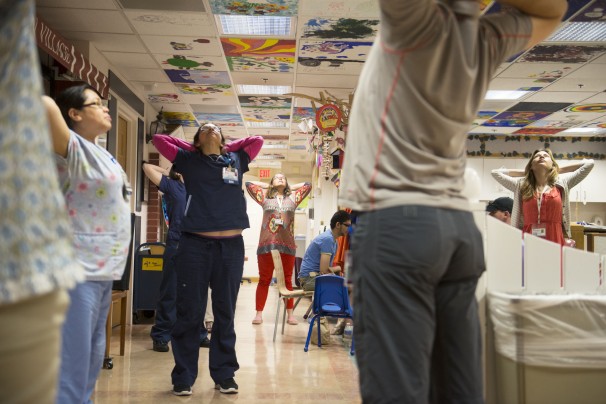
The Washington Post story below is about nurses and how they deal with patient burnout but their solutions could be our solutions too:
 
Nurses at the Georgetown Lombardi Comprehensive Cancer Center
do stretching exercises
Photo by Marvin Joseph/The Washington Post
 

http://articles.washingtonpost.com/2013-06-10/national/39865768_1_burnout-intensive-care-unit-nurses