Showing posts with label cancer. Show all posts

Tuesday, November 19, 2013

Kris Carr's Golden Ticket

I recently wrote about some of the good things I learned about surviving a personal trauma in the ten years after my husband's death (No Lifeguard On Duty).  After that post was published, many people told me they found it helpful to know how things feel ten years after a loss.
 
No matter how crazy and afraid you feel after a loss, it's essential to keep trying to find the support you need until you discover a different way to live.  Even though change is the last thing you want to do, change is possible.  It feels as though nothing will ever go right for you ever again, but that my friends, is a feeling that eventually will pass if you give it some time.

There is always hope.
 
The idea of changing and rebuilding your life, working on personal development or sustaining a lifestyle change over a ten years period is so interesting to me.  How do other people do it?  What keeps them committed to their new way of life?  I was Googling to see if I could find out more about how others mark their personal benchmarks of change when up on the computer screen popped the name of one of my favorite inspirational people: Kris Carr.
 
Photos Courtesy of Kris Carr
 
Kris Carr is truly amazing to me.  I have written about her many times on Cry, Laugh, Heal and never tire of her enthusiastic, original and generous way of approaching life as a person diagnosed with a Stage 4 cancer. 
 
Kris Carr is a New York Times bestselling author and wellness activist who brings you to the idea of change in a best girlfriend, let's do this together kind of way.  Whenever I am in a rut or feel the need to kick myself in the butt to get motivated, I either pick up one of her books or read her blog, Crazy, Sexy Cancer (www.kriscarr.com).  Kris Carr recently went in to the doctor's for her ten year check up and talked about it on Oprah's amazing weekly program called Super Soul Sunday.
 
Please watch this short YouTube clip and listen to Kris Carr talk about her changed life ten years after being diagnosed with the Big C:

http://www.youtube.com/watch?v=k5cE3OnOZR4&feature=player_embedded

Thursday, August 22, 2013

News That Inspires

I don't know about you, but when I read newspapers, magazine or books, I am always looking for stories about people who have overcome a tragedy or some other kind of obstacle in their lives.
 
I am always amazed when I read about how someone who has experienced the death of a loved one or another kind of personal crisis then manages in the midst of this personal pain to find reserves of inner strength to work through their conflicting feelings and move forward to pursue something positive.  The same is true of someone whose life seems full of things going wrong yet somehow works through those obstacles and turns their life into something constructive.
 
In reading about someone else's story, no matter what the situation, I find that something clicks within me and I am reminded that I am not alone in my healing journey.  Life hands you choices that you don't expect and frankly don't like at all.

But life then also shows you that others have burdens or baggage, if you will, and I am inspired by people from all walks of life who expose their human and vulnerable side to the world and aren't afraid to recount what has happened to them and how that sadness affected their world but they decided to rise above it.

I love sharing these stories with you, my fantastic readers, and I hope you find them inspirational too!  I know I can't do it alone and I when I read about how other people handled their tragedies, I say to myself that if this person moved forward with their life then I can do it too!

This particular story that I read recently in The Washington Post is very uplifting to me.  It concerns a mother named Annette Weller and her daughter, Lauren Weller Sidorowicz, who sadly lost her valiant battle with bone cancer in 2011.  One day during Lauren's eight year stay at the pediatric unit of the National Institutes of Health Clinical Center, a pediatric cancer psychologist dropped off some colored markers and told Annette that she could draw on her daughter's window if she wanted.

Photo Courtesy of The Washington Post
The human spirit can be resilient in its ability to take a wide range of feelings and thoughts and channel them in a therapeutic way through drawing, painting, writing, singing or even sewing that can lead to a healing of broken heart.

Please read this touching story about Annette and Lauren and how Annette now uses her art to help others: 
 
http://www.washingtonpost.com/local/colorful-murals-keep-a-daughters-memory-alive/2013/08/12/37f0234c-0105-11e3-9a3e-916de805f65d_story.html

Thursday, August 15, 2013

Hair's To You

Today I am giving a huge shout-out and a huge hug to a person I know who has just finished an intense round of chemo treatments and is dealing with the loss of their hair.
 
This person is showing so much courage and positive thinking in their intense and aggressive fight with cancer.  This person also happens to be the third person I have known to lose their hair during chemo and I totally get why this stage is so traumatic: hair loss makes the cancer obvious and visible to others.
 
From talking to these people about experiencing their hair loss, the first instinct is denial.  Each person tells themselves it will not happen to them and then they want to hold on to every strand of hair they have.  Our society happens to see hair as health.  In fact, lots of hair is equivalent to good health and vitality.
 
So when your hair starts to fall out in clumps from chemotherapy, most people, men and women alike, want to start wearing a wig.  The women's wigs are really nice but the men's wigs have a really long way to go in looking like real hair.  Instead, I think the men should go for it and just shave their heads.  It's a very Steve Harvey/Bruce Willis look (Harvey and Willis are not cancer patients just to clarify) and I think most women think it's sexy.

Steve Harvey
 
 
Bruce Willis
 
Plus there is something empowering about taking the initiative to decide to shave your head when your hair is falling out or when you are facing cancer in general.  This exceptional person I am thinking of today now just takes his hat off and shows you right away what is going on and then continues to talk about the positive things he is doing while receiving treatments.
 
Chemotherapy drugs are super powerful medications that attack rapidly growing cancer cells.  Unfortunately, these same drugs also attack other rapidly growing cells in your body, particularly those in your hair roots.
 
But the good news is that hair loss is temporary.  It's going to grow back, no doubt about that.  It may be a different color and it may be a different texture, but it will be hair and it will be yours.
 
Of course it is easy for me to say what looks good because I am not a cancer patient and am not experiencing the turmoil of cancer's life and death decisions.  I have the luxury of standing back and saying this is what I would do if I were losing my hair.  If it were actually happening to me, I probably would feel distraught and very scared.
 
And so I salute all cancer patients who are in the hair loss phase of their treatment.  May you continue to be brave, strong and resilient in your battle for wellness. 
 
We are with you!  

Wednesday, July 3, 2013

Preventing Burnout

Holidays are the best!  They always seem to arrive at the right time, just when we need a break from our daily routines.  Just when we need time out to relax and recharge.


Holidays help us take a break, both mentally and physically, from the responsibilities we carry out every day. I intend to sleep in, exercise more, hang out with friends, and read.  I do all of these things on a regular basis but holidays allow me to do them for longer, uninterrupted periods of time.  And I can do them spontaneously which adds to the fun.
 
Holidays also opens up our creative juices and gets us to thinking of different ways to decorate our houses, apartments or even ourselves!  We try new recipes and sometimes even travel to a new place.
 
When we continually do our work routines or personal responsibilities over and over again in just the same way, every day, with hardly any break in the routine, we can start to burn out and then things start to go bad.  You can be on the path to burning out and not really know until it's too late.  Others probably know it because they see a change in you, but you are probably determined to power on, pushing to do what you need to do at all costs.
 
It's time to take a break!
 
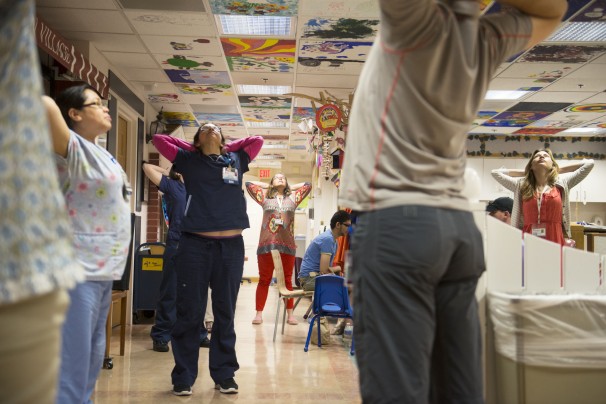
The Washington Post story below is about nurses and how they deal with patient burnout but their solutions could be our solutions too:
 
Nurses at the Georgetown Lombardi Comprehensive Cancer Center
do stretching exercises
Photo by Marvin Joseph/The Washington Post
 

http://articles.washingtonpost.com/2013-06-10/national/39865768_1_burnout-intensive-care-unit-nurses

Thursday, June 6, 2013

Digging Deep

I have previously written about people I know who are fighting the good fight against cancer.  Three of them at this point are in good health while one is gearing up for the fight of his life.
 
He is getting ready for surgery next week and after that he enters an intense, aggressive program aimed at totally killing this sucker in its tracks.  He has an amazing attitude towards this scary situation and I admire his calm and even demeanor.


Put in the same situation, I know I would not be faring so well and I don't think I would be inspiring anyone with my raw reaction to fighting a cancer within myself.
 
From talking to my friends, they say that first comes the disbelief that your body is so sick; that your body is basically at war with itself.  Your mind and heart are racing, racing at an incredible pace and you can't catch your breath as you take it all in.  While trying to come to grips with what the doctors are saying, you sometimes detach from reality a bit and feel as though you are outside yourself.  I understand this feeling very well because in the first few months after my husband's death, I definitely was outside myself.  I think it is your mind's way of temporarily buffering you from what's happening and giving you a way to cope.

Facing pain, whether physical, mental or a combination of both, can be isolating.  There is an intense feeling of letting the rest of the world fall away as you focus with laser concentration on what you need to do, have to do, to find wellness.
 
It is now a time of digging down deep and calling upon God to watch over him.  It is a time of feeling human and vulnerable.  It is a time of pulling out all the stops to give love, support and everything else we as a family can find to throw at him as he faces and fights this dreaded, yet survivable, disease.

Thank you for being here.  Peace.
 

Wednesday, April 10, 2013

A Positive Attitude In Cancerland

I don't always feel positive about all of the situations that life throws my way but I do feel very positive about life.
 
Would I continue to feel positive if I were diagnosed with cancer?
 
I would hope so!  I would hope that my love of living, my love for my family and friends and my love of life in general would kick my fighting spirit into high gear and that I would become determined not to let cancer win.
 
But that's easy for me to say because I have not been diagnosed with cancer.  I know a handful of people who are battling cancer right now and I have learned a lot from them about life, mental outlook, pain and especially love.  I never take my good health for granted.  I work hard to keep myself mentally and physically healthy and by the grace of God, I will stay that way.
 
In the sweet story below, Joel Achenbach, a fantastic reporter and writer for The Washington Post, writes of his mother's optimistic attitude since her breast cancer diagnosis and surgery.  What a warm and courageous woman she is! 

 
Photo By Joel Achenbach/The Washington Post
Joel Achenbach's mother, selling plants at a spring garden festival
 soon after she has surgery for breast cancer

Cancer hasn’t dimmed my mother’s upbeat attitude. How far can optimism take her?

By , The Washington Post 

Published: April 1


A few weeks ago, I took my mom shopping for a refrigerator to replace the one that had been in the kitchen since the Nixon administration. Pleasantries with the salesman took a more somber turn when he revealed that his wife has breast cancer and is seeking to heal herself solely through the power of prayer. My mom listened attentively, then touched the salesman on the chest and said, authoritatively, “Carrot juice! And blueberries!”

 
She is a believer in the restorative powers of fruits and vegetables, and of wholesome living more generally. She doesn’t reject modern medicine, nor would she seek a miracle cure through prayer or New Age therapies. But she is not someone terribly interested in medicine, or technology in general, preferring to exist in a world that is like the one she grew up in — simple, natural, earthy. She has spent her years outdoors, growing plants, doing landscaping, surrounding herself with flowers. She has often ended the day with a cold beer under the grape arbor in her back yard. The yard is a two-acre botanical wonder where she and my stepfather, Jim, have their nursery, plus a robust garden, productive citrus trees and winding footpaths among native plants and towering trees.
 
I called to check on her the other day. After quickly assuring me she was fine, she launched into a prescription for how I might reduce some minor leg pain that’s been bothering me: “Point one foot at the North Pole and one foot at the South Pole and bend over and touch the floor,” she said.
 
Though full of medical advice for others, she doesn’t talk much about her own illness, and it didn’t seem to occur to her to tell the appliance salesman that she, too, has breast cancer, stage 3. Here’s the key fact about my mom: She doesn’t consider herself sick.

She’s the opposite of a hypochondriac, never missing a chance to brag about her unusually good posture and the physical strength that many women her age would envy. She informs doctors that her nickname is Tough Lady. When I asked her if I could write something about her medical situation, she said, “Make sure to include what I tell every doctor: ‘I’m not old, and I’m not sick!’ ”

No question, she has a wonderful attitude, and her sunny disposition if distilled and bottled would be sold in every drugstore on the planet.

A fine line

But an objective account of Emily Notestein’s health history, and of her attitude toward medicine, would surely note that she has not been a diligent student of her disease and that she showed no interest in seeking aggressive treatment when it first appeared. There is a fine line between optimism and denial. The power of positive thinking goes only so far.

How aggressively we deal with cancer hinges in part on age and whether the disease threatens to truncate a life dramatically or merely lop off some years in the final decade or two. And cancer in a septuagenarian can be more indolent than cancer in a young woman. Thus, an older person like my mother faces a different mental calculation than someone who is in the prime of her life. Cancer at 76 doesn’t feel like a tragedy.

My mother first had breast cancer two years ago; she had a lumpectomy and no further treatment. She insisted that she didn’t need chemotherapy or radiation or a combination thereof. A plausible scenario is that she was stunned by the high cost of the procedure, and lacked Medicare Part B coverage, because back when she was 65 she felt no need to sign up for something that would be useful only on the very off chance that someday she would have a medical problem. (“I was healthy!” she told me when I pressed her on it.) What’s indisputable is that the cancer came back in the same breast.

On my Mom’s 76th birthday, in late January, her surgeon performed a mastectomy and also removed 22 lymph nodes.

“Everyone was so nice to me!” Mom said that afternoon, groggy from the outpatient procedure. She didn’t feel as if she’d been mutilated. She felt that she’d been the star of the show.

The next week, she heard the pathology report, and it wasn’t good: cancer in all 22 nodes, officially stage 3 cancer. The initial chest X-ray showed no tumors in vital organs; a subsequent PET scan also turned up no sign that the cancer had spread beyond the nodes. “It’s curable,” Mom said, getting right to the point.
 
She’s being treated at a cancer center by an oncologist who has his hands full. Twice during the brief initial consultation, he was summoned from the small examination room by nurses dealing with emergencies.

I asked him if the cancer looked aggressive.

“It has some characteristics of being rapidly acting,” he said.

He went through the whole scenario: Chemotherapy for 18 weeks, then radiation for six weeks, then years of hormone therapy. Mom would get a port surgically implanted, then receive three cycles of cytoxan, epirubicin and fluorouracil for nine weeks, followed by three cycles of Taxotere for another nine weeks.

My mother took no notes. I later suggested that she research her disease thoroughly. But whereas I saw a problem to be solved, she saw one to be ignored to the extent humanly possible. Her doctor is the expert; she’s the plant lady. She’s going to live her normal life, and won’t spend time, mentally, in Cancerland.

Built to last

All is not as it was, of course. She’s slower since the surgery. She’s got less “steam,” she says.
She hasn’t had the easiest life, though her third marriage has lasted nearly four decades now. She was a divorced, single mother by the age of 25, working as a saleswoman at Sears while trying to take care of two semi-feral boys in an old wooden house with a leaky roof. We had some lean years, but my brother and I knew we were loved unconditionally.

My mother inherited a strong work ethic, and remarkable powers of endurance, from her forebears back on the farm in Indiana. Her family didn’t have indoor plumbing until she was 12 years old. My grandfather as a boy would plow the fields behind two Belgian draft horses, and would know it was time to come home for supper when his mother hung a sheet in the window. “Tell me about the horses, Dad,” my mother would say to my grandfather when he was deep into his 90s and clung to his murky memories as if they were handrails. He and my grandmother both lived nearly a century. So my mother is built to last, if she can just make it through her next challenge.

I can’t be sure of this, but she seems to be appreciating the world more than ever. My mother is not a society lady, isn’t a member of a club and hasn’t been to church in quite a while. But she is interested in everyone and everything. She is egalitarian down to her last molecule. When we went to Wal-Mart, it was hard to make much progress toward the kitchen section because she wanted to greet everyone along the way. She doesn’t seem to grasp the concept that the official Wal-Mart greeter is supposed to be an employee, not a customer.

Throughout her life, small pleasures have struck her as marvelous. A sandwich nicely prepared is a cause for rapture. In a field of weeds and rubbish she will see, and rejoice in the miracle of, the lone flower.

“Death holds no terror for me,” she always says.

Fear and anxiety are adaptive traits to some degree, and the perpetually sunny disposition may not invariably offer an actuarial advantage. I worry that her rose-colored glasses are blinders. But her attitude makes the process easier on everyone else. That’s a form of caregiving. It’s a gift from the sick person to those who worry about her.

I called her from Washington after her first round of chemotherapy.

“It was a nonevent!” she reported. “It lasted awhile and I got hungry, so afterward we went to Wendy’s and I had a baked potato. It was delicious!”

Chemotherapy, in time, will surely beat her up, and she’ll lose her hair, and her melodious singsong voice, her trademark feature, may weaken. But will she ever feel sorry for herself? I don’t think she’d know how.

As an analytical person, science-oriented, I find it hard to ignore the medical realities here, but my mother in her congenital sunniness is strangely persuasive. And so I have no choice but to believe her: She’s not old, and she’s not sick.

© The Washington Post Company

Tuesday, April 2, 2013

Robin Roberts' Message

Robin Roberts is courageously showing us how to be "all in" about life.
 
Over the weekend, I read Parade Magazine's interview with Roberts, ABC's news anchor for Good Morning America.  It is no secret that Roberts was diagnosed five years ago with an aggresive form of breast cancer and for the past year she has been fighting a rare life-threatening disease called myelodysplastic syndrome (MDS) which affects the blood and bone marrow.


Roberts is now back on the job which is miraculous given the physical and emotional toll of her chemotherapy, bone marrow transplant and fragile immune system.  But life changing events can sometimes make us stronger and Roberts' message resonated with me.
 
When you lose someone you love or you fight with all of your resources to overcome a disease, life becomes heightened.  Things that happen in your daily life that you once took for granted are no longer things to overlook and expect to have happen to you over and over.
 
Every day I try to make myself conscious of what the sky looks like, how the flowers smell, how good it feels to be able to walk down the street and breathe deeply and feel healthy.  I have a precious life and I am going to try and be mindful not to waste it.  Because I know that those are things that can be taken away very quickly.  And so does Robin Roberts.
 
Asked by Parade Magazine how her experience has changed her, Roberts says, "I am stronger than I thought I was.  My favorite phrase has been 'This too shall pass.'  I now understand it really well."
 
And here's the really cool part.  Roberts does something I do a lot when I am feeling stressed at work: visualization.
 
When work is piling up, I try to mentally check out for a few minutes before I dig in.  For me, I visualize myself standing on the beach.  I love the beach so much that I visualize myself there at all different times of the day.  I try to hear the waves pounding the shore and bring the smell of the ocean back to my memory.  After I mentally visit the beach, I take a deep breath and put my head down and just do my work until it's done.
 
Roberts told Parade Magazine that to fight her fears, she practices yoga and visualization.  "When I close my eyes, my happy place is Key West, coffee in hand, sunrise over the pier, Roberts said.  "I can visualize that in the studio and it has helped calm me."
 
No matter what today brings you, you will survive it, and if you feel yourself becoming anxious then visualize your own "happy place."
 
You are fortunate.  You are alive and a new day awaits you.
 
What will you do with it?

Thursday, March 7, 2013

Reflections of Nora Ephron's Son

 
Nora Ephron
Crying is unsettling.  Especially if you are watching one of your parents do it.
 
My son hates it when I cry and has said that when I would cry all the time immediately after his father/my husband's death, he would feel this mix of emotions that he didn't want to feel and so he would walk away.  I understand it and think his reaction was perfectly normal.  He was thirteen years old and dealing with something that adults find hard to handle.  He was just trying to survive.
 
Now, at twenty two years old, my son explains his reaction this way: "When children see their parents cry, it's like a wall being broken.  It messes everything up.  I wanted you to be my Mom but when I saw you cry, it's like you weren't my Mom anymore.  You were a person and I didn't want that. I wanted my Mom."
 
It makes sense to me and I love him all the more for his insight; as painful as it was, and sometimes still is, for both of us.
 
That is why Jacob Bernstein's long and loving story about his mother, Nora Ephron, is so powerful and compassionate.
 
It's a universal story of how children feel about their parents as children, and as adults, and especially sons and their feelings about their mothers.
 
But having an accomplished, high-profile, multi-talented mother such as Nora Ephron is a unique story. And Jacob Bernstein writes it beautifully.  I knew it was a long story so I only intended to read the first page and then come back to it later, but then I couldn't stop reading it until I reached the end.

His mother is proud.  He took good notes.

Please click on this link to read Jacob Bernstein's story as it appeared in the New York Times magazine this past weekend:

http://www.nytimes.com/2013/03/10/magazine/nora-ephrons-final-act.html?_r=3&hp=&adxnnl=1&pagewanted=1&adxnnlx=1362652331-n02tv3ThoWXX1qcUk6JoRw

Tuesday, March 5, 2013

The Loss of A Child

When I have been in support group sessions and listened as people have talked about losing a spouse there is usually a sense of bonding, a feeling of "having been there" in the expressed feeling or thought.  A supportive dialogue usually ensues and sometimes people even feel a sense of progress.
 
Being around other widows and widowers can be a blessing after you have lost a spouse.  I remember thinking, "Finally! Here are people who are dealing with what I am dealing with!"  Because of our shared experience, we could tell jokes or cry or get angry about the loss of our loved ones.  I think we even began to think that maybe losing a spouse is something most adults eventually have to experience.


I remember though when a woman whose husband had recently died began talking one day about how she also had lost her child.  I felt a stillness and reverence come over the room.  The death of anyone you love permanently changes your life.  A spouse, a parent, a friend.  There is always a yearning for more time and a need to connect even after they are physically gone.

But the death of a child is in a category all by itself.  Such a profound loss is unbelievably cruel and goes against the natural order of life.  

Anyone who can talk, let alone sit down and write a complete and rational thought about their deceased child is a person who is truly resilient.  Jeremy Shatan is one of those people.
 
Please read about his beloved Jacob in the following New York Times story and some of the jarring events that have marked Jeremy's journey since Jacob's death.


March 3, 2013

A High-Functioning Bereaved Parent

By JEREMY SHATAN
So where am I now, 13 years after my 2½-year-old son, Jacob, died because of a brain tumor? One thing I can say is that my junk mail has no idea where I am. The other day I threw out yet another letter offering to give us advice on Jacob’s college career, as well as a solicitation to re-subscribe to Highlights magazine. Obviously, Jacob is not going to college. And my surviving children are 11 and 13, a bit out of the Highlights demographic.
 
One construct I use to help myself understand where I am now is a term my wife and I came up with: High-Functioning Bereaved Parent. As is often remarked, someone who has lost a spouse is handily defined by the word “widow” or “widower.” But there is no shorthand to describe a parent who has lost a child. Language is a reflection of culture. The great majority of people will never experience the loss of a child and would prefer not to think about it all that much. Raising children is fraught enough without having to dwell on their mortality. So for now, H.F.B.P. will have to do. I’ll certainly take it over “every parent’s worst nightmare.”
 
So how exactly does being a High-Functioning Bereaved Parent manifest itself? I get out of bed, I help raise our kids and run our household, I laugh, tell jokes, watch violent movies, listen to music and go to concerts. So it all looks pretty good from the outside, and it usually feels … not bad, which is how I prefer to answer when someone asks me how I’m doing. I have no doubt that much of this equilibrium comes from the fact that my wife and I have been together through all of this and still find a lot of joy in our marriage and our surviving children. I also have the privilege of being the executive director of Hope & Heroes Children’s Cancer Fund and working every day to improve the lives of children with cancer alongside the staff of the Herbert Irving Child & Adolescent Oncology Center. Among bereaved parents, I consider myself very lucky that I get to work for Jacob every day.
 
But I knew from the moment Jacob died that we would never get over his loss; we would only learn to live with it. At the risk of torturing grammar, perhaps I should revise that mantra to be “we would only be learning to live with it,” because it’s a process that never stops.

One way I know that is from the physically jarring sensation I feel when the huge chasm in my life abuts the solid ground I usually walk on. It could be at a high school information seminar for my daughter, for example. There’s just this moment of wrongness. Somewhere in my soul there’s a trajectory for Jacob’s life that is still going on, a part of me that wonders why we haven’t already hit these milestones with him first. The natural order of things has been disturbed, but that hasn’t entirely stopped me from attempting to hew to that order. Or it could happen with a change in the weather, which can trigger a sense memory sending me back to the time when Jacob was being treated.
 
That aspect of things is a form of post-traumatic stress disorder, I suppose, which feels like unprocessed experiences that my brain is constantly working on behind the scenes. A hint of fall in the air, and the curtain is momentarily yanked open, exposing the churning attempt at understanding what happened.
 
For reasons like those, some days are more effort than others. Also, occasionally my status as an H.F.B.P. can lead to a balancing act in relation to my work. Naturally, I can empathize with the parents I meet at the clinic — I have walked in their shoes. But since Jacob did not survive, I don’t want to shake their carefully constructed hope that their child will. One thing I always make sure to convey is that each diagnosis is unique and that treatments have continued to improve. My perspective still allows me to have hope for others, and if things do take a turn for the worse, I can offer the powerful example of my own survival after the loss of my son.
 
But it hasn’t always been that way. In the emotional chaos shortly after Jacob died, my wife and I took our infant daughter to a retreat for bereaved families provided by Chai Lifeline. We were already wrung out, but this was a new form of wringer: story after story of gut-wrenching, unimaginable loss. My wife got a migraine so intense that the rattle of a newspaper caused her pain; we considered leaving after the first night.
 
We stuck it out, and through the haze it dawned on us: you can live on after the loss of a child, it’s not impossible. After the retreat, when the sadness would threaten to become overwhelming, I would think of these other bereaved parents and take strength from their behavior. Regular conference calls with a group of dads also helped a great deal.
 
So my path has not been through completely uncharted territory. I have had mentors to follow, whether or not they would have called themselves High-Functioning Bereaved Parents. In the end, I’m not sure if being an H.F.B.P. is a choice, exactly, but I believe that putting a name to our “condition” has helped us not just survive, but to thrive and engage with life more fully.

Jeremy Shatan lives in Inwood, Manhattan, with his wife and two surviving children, is proud to serve as Executive Director of Hope & Heroes Children’s Cancer Fund, and writes about music at LINK 3 AnEarful and @AnEarful.

Monday, January 28, 2013

Comfort Dogs


"Charlie"
 
 They say that dogs can sense when people need comforting.
 
And when dogs feel a person's fatigue, sadness or loneliness, it is in their nature to give companionship and sometimes entertainment to the person in need.
 
I have been watching the generous spirit of a new puppy named Charlie who has joined the family of one of my sisters.  Charlie is full of so much energy and love and he just can't wait for someone to hold him and play with him.  Charlie is a King Charles Cavalier Spaniel and he has an uncanny sixth sense about which person in the family needs him the most.

I guess I am discovering what others have already known about dogs and their sense of loyalty and kindness.
 
When I talk about dogs and entertainment, I definitely have Charlie in mind.  Can you imagine a dog who likes for people to put outfits on him?  Well, Charlies does and he can't wait for someone to either put a dog sweater on him or a Redskins jersey (dog size of course!).  Charlie is definitely on the cutting edge of dog fashion.
 
But seriously, Charlie has had a special healing effect on those around him and has made everyone temporarily forget the tensions and stresses of the day when he is around.  It is amazing how his sweet temperament affects everyone around him and he is especially great at providing comfort to people in the midst of serious medical treatments.
 
He will jump up in a person's lap and then suddenly be very still as the person gently strokes Charlie's cute ears or holds his small body.  In fact, Charlie offers every bit of a calming influence, and maybe more, as the infamous K-9 Parish Comfort Dogs do.
 
The K-9 Parish Comfort Dogs were brought into Newtown, CT immediately following the tragic shooting massacre of more than 20 children and teachers at Sandy Hook Elementary School in mid-December 2012 to ease the pain of survivors and parents whose children had died in the tragedy.
 
The K-9 Parish Comfort dogs are trained to interact with people at churches, schools, nursing homes, hospitals and in disaster situations.  According to K-9 Parish Comfort dog's FaceBook page, a dog "is a friend who brings a calming influence, allowing people to open up their hearts and receive help for what is affecting them."
 
Check out these special healing pictures of the K-9 Parish Comfort dogs doing their best to help children and adults heal and feel better about their lives:

http://www.buzzfeed.com/jtes/photos-of-golden-retrievers-comforting-the-residen

Monday, January 14, 2013

An Honest Dialogue

After a loss, people often feel that they have no resources.
 
They feel they have no one to talk to about the extreme pain they are feeling.
 
A little over two years ago, I launched Cry, Laugh, Heal as a place where people could go to read and discuss grieving and say to themselves, "I'm not alone.  Someone else gets it."
 
Because in the end, no one ever wants to feel alone.
 
Since starting the blog I have written about grief and about the crucial process of trying to put the pieces of your life back together after the death of a loved one has blown it apart.  Besides grief, I have also explored the topics of nutrition, friendship, humor, honesty and raising a child by yourself after the death of a spouse.  Grief is a multi-dimensional issue and I think the above topics are but a few of the many handy-dandy tools that are related to surviving a loss.
 
I have found that an important part of grieving in a constructive way is acknowledging it, facing it head on and not running away from it and all of the shock and pain it causes.  Calling it what it is is soooo important.

Another crucial part of the grieving process is to reach out to others.  Do not be afraid to talk about your grief.  I'm not saying it's a 24/7 topic.  No topic can be talked about all the time.  But don't be afraid to say to someone you know who cares about you, "I feel awful" or even "I'm scared.  I have no idea what's going to happen next."
 
You will connect.
 
As did this very brave woman who is the subject of today's post.  Her final connection is truly powerful and was written about recently in the New York Times.  This woman found an inner peace and was not afraid to talk about what was happening to her.  Her story is raw yet she is courageous in an unprecedented way, giving of herself, reaching out and sharing until the end.
 
Please read this incredible story, share it and talk about it:


Martha Keochareon

As Nurse Lay Dying, Offering Herself as Instruction in Caring

SOUTH HADLEY, Mass. — It was early November when Martha Keochareon called the nursing school at Holyoke Community College, her alma mater. She had a proposal, which she laid out in a voice mail message.
      
“I have cancer,” she said after introducing herself, “and I’m wondering if you’ll need somebody to do a case study on, a hospice patient.”
      
Perhaps some nursing students “just want to feel what a tumor feels like,” she went on. Or they could learn something about hospice care, which aims to help terminally ill people die comfortably at home.
      
“Maybe you’ll have some ambitious student that wants to do a project,” Ms. Keochareon (pronounced CATCH-uron) said after leaving her phone number. “Thank you. Bye.”
 
Please click on this link for the whole story:


Friday, January 11, 2013

Cooking for Children With Cancer


Danielle Cook Navidi (in apron)
Photo Courtesy of Georgetown University Hospital

If you ever doubted that one person can make a difference, then please meet Danielle Cook Navidi.
 
Navidi is a loving mother totally committed to the idea that she could cook healthy food for her then 11-year-old son, Fabien Navidi-Kasmai, diagnosed and receiving treatment for Stage III Hodgkin's lymphoma.  His taste buds were shot, he couldn't digest his favorite foods and sadly, he would go for days without eating. 
 
Navidi reminds me of many mothers I know who are steadfast in their beliefs about what can help their children even when others, such as doctors, tell them that their ideas won't work.  Their motherly instincts tell them that they are right and they are determined to find a way to make it work for their children.

Nutrition was not a priority for the doctors.  They told her it was fine if he ate fast food but Navidi knew he needed fresh nutrients in his system if he was going to remain strong enough to fight the cancer.  She couldn't accept the idea of feeding McDonald's to her son and instead went back to her own kitchen and started cooking what most mothers give their children when they are ill: chicken soup.
 
There's something primal about wanting to cook for family, especially when someone is ill.  The prepared food is a reflection of your love and concern and also a way to nurture your loved one back to good health.  Cooking can be an incredibly healing experience, taking you out of yourself as you taste and experiment, hoping for maximum deliciousness!!  
 
Navidi made the soup herself and expanded the recipes to accomodate her son's cancer treatments.  He was able to digest her homecooked meals and gained weight.  Today, Navidi's son, Fabien, is 19-years old and, thankfully, in remission.

And her story gets better.  Navidi started volunteering at Georgetown University Hospital in 2008 making smoothies for other children at the hospital being treated for cancer.  She now offers free cooking class at Georgetown to the families of children with cancer and turned her recipes into a book titled "Happily Hungry: Smart Recipes for Kids with Cancer."

What a Mom!!!!  Here's her full story which was recently written about in The Washington Post:

Cooking for kids with cancer

By , Published The Washington Post: January 8

When in doubt, start with chicken.
 
That’s the lesson Danielle Cook Navidi learned after her 11-year-old son, Fabien Navidi-Kasmai, was told he had cancer, and the only nutrition advice she received was, “Let him eat McDonald’s. He needs the calories.”
 
Navidi, an avid cook with a love of farmers markets and a background in catering, was appalled. But she was also at a loss.
 
Fabien’s body, his digestive system, his taste buds and even his cravings were being ravaged by his illness, Stage III Hodgkin’s lymphoma, and by his medical treatments. He would go for days without eating. When he did, he had trouble keeping down even his favorite foods. Navidi didn’t know how to feed him anymore, but she was convinced fast food was not the answer.
 
“So I started with the basics,” says Navidi, a Washington resident. “I grabbed a pot, put a chicken in, added some vegetables. There were days when he’d have chicken soup at 10 a.m. because it worked for him. Now that’s what I tell other parents: Start with the chicken.”
 
That back-to-basics approach is the backbone of Navidi’s free Cooking for Cancer classes at MedStar Georgetown University Hospital and her cookbook, “Happily Hungry: Smart Recipes for Kids with Cancer.”
 
“I never thought I’d be here,” Navidi says, stirring a pot of red beans and rice soup with kielbasa, which is simmering on a hot plate in a corner of the hospital’s kitchen-less pediatric oncology waiting area. The room, filled with art projects and board games — and now, thanks to Navidi, the smell of simmering sausage — is a place where children pass the time between checkups and treatments.
 
Eight years have passed since her own son was here, undergoing surgery, chemotherapy, radiation and blood transfusions.
 
Navidi is no longer the worried mother — 19-year-old Fabien’s cancer is in remission — but there are plenty of other parents in that position. Navidi’s job is to share recipes that might lighten their burden or, at the very least, distract them during the long hours spent waiting.
 
A holistic nutritionist, Navidi began volunteering at MedStar Georgetown in 2008. “I pretty much just asked, ‘Can I take a little spot and make smoothies?’ ” She would do prep at home, pre-cooking anything that required a stove or oven, and showed up at the hospital with bags of groceries.
 
Navidi’s commitment and willingness to pay for food and supplies out of her own pocket drew the attention of Aziza Shad, chief of MedStar Georgetown’s pediatric hematology-oncology program. Shad helped find grant money to fund the program and encouraged Navidi to compile her recipes into a book.
 
“As an oncologist, you have to make sure your patients are in good shape nutritionally,” says Shad. “If a child doesn’t eat well, he can’t handle chemotherapy well. Nutrition is medicine. It’s all connected.”
 
Shad says cancer treatment has a major impact on appetite. Sores can develop in the mouth, throat and gastrointestinal tract. Foods that are raw, acidic or greasy become hard to digest. Food, even water, can begin to taste metallic due to changes in the lining of the mouth. Stress on the body leads to new cravings.
 
“Everything gets really out of whack,” Navidi says. “Fabien used to crave burritos, and it just made him so sick.” Recognizing that what he really wanted was salt and fat, Navidi encouraged him to eat olives and feta cheese instead.
 
Through the cooking classes and the book, Navidi says, she tries to show parents that real, whole foods don’t have to be inconvenient.
 
“Food and health can be a very sensitive topic. Families know that their food choices are not always the best,” she says. “They will come in with bags of fried chicken that they munch on [while waiting]. I try not to be judgmental. We sit. We talk.”
 
The cooking classes are free, informal presentations open to patients and their families. They’re held once each week from 10:30 a.m. until around 1:30 p.m. The classes are appropriate for the whole family; parents learn practical tips, such as how to peel squash and grate ginger, while kid-friendly steps such as mixing ingredients and pressing buttons on a blender allow children to participate.
 
For Tanikka Cunningham’s family, the classes are as much a distraction from the reality of childhood cancer as they are a lesson in cooking. In July 2010, doctors told the Loudoun County resident that her 3-year-old son, Sekhu, had leukemia. He is now 6 and in recovery; he visits his doctors twice a month and often sees Navidi on those occasions.
 
“When your child is sick, your time is just focused on trying to keep your family going,” Cunningham says. “Everything else,” including healthful eating, “takes a back seat.”
 
She says the classes are a reminder to make nutrition a priority, and they provide a creative outlet for her son.
 
Sekhu sidles up to Navidi, who asks if he would like to help make a cranberry-pear smoothie. Sekhu looks from Navidi to his mom and back again, nodding excitedly. Navidi shows him how to add the ingredients to the blender. He giggles, successfully pouring everything in without spilling. Behind him, his mother is smiling.
 
In addition to soups and smoothies, the 43 recipes in “Happily Hungry” include comfort foods such as warm potato salad with black olive and mint pesto, and hazelnut-chocolate chip brownies. They’re focused on flavor, digestibility and easing side effects of cancer treatment, such as nausea, fatigue, dehydration and compromised immune function.
 
Navidi is toying with the idea of writing a second cookbook this year and dreams of expanding the Cooking for Cancer program. She hopes someday to install a full kitchen in the hospital, but her larger goal is to help parents beyond the walls of MedStar Georgetown.
 
“There’s a feeling of not being in control of the situation when your child is sick,” Navidi says. “And when you’re cooking something they like, when you feel that you’re helping. . . . That’s everything.”

The “Happily Hungry: Smart Recipes for Kids With Cancer” cookbook is available for purchase online at Amazon.com. For information about the program at MedStar Georgetown, call 202-342-2400.
 
© The Washington Post Company


Tuesday, December 4, 2012

Melissa's Story


Melissa Betrand Knights (baseball cap) with her children

 
After a loved one dies, we try to find ways to stay connected to them even though they are no longer physically with us.
 
Our memories of being with that person or just of the person by themselves is a strong tie that can never be broken.  Sometimes we save a piece of clothing they wore or some everyday item that brings great meaning to us.  Being in a particular place, smelling a scent or hearing a song can bring those strong memories back to us without any notice but sometimes that is not enough.
 
We want to honor the deceased person and what their lives meant to us.  We can't control loss in our lives but we can create memorials that enable our loved ones to live on in our hearts and help us to heal and move forward.
 
Memorials can include something as big and as public as an annual award, a large charitable donation in the deceased person's name or a webpage or website set up in the person's name.  If that doesn't feel appropriate, a memorial can also be something small and personal such as a garden or a special scrapbook.

Or you could organize a walk/run event to honor, remember and support those in your community who have been touched by cancer.

This is what the Knights and Kaderli families of upstate New York have been doing for 24 years since a member of each of their families lost their fight with cancer.  The families organize their communities every year and raise money to give to families who are having financial problems while a loved one undergoes cancer treatment.

The following essay is beautifully written by Melissa Knights Betrand and was recently published in her local newspaper, The Daily News of Buffalo, NY.  Melissa is the sister of a colleague of mine, Aaron Knights, and I wanted to share their inspirational efforts to highlight how two families, in the midst of tragedy, found a positive and powerful way to remember their loved ones who had battled and sadly lost to the demon disease of cancer.

Here is Melissa's story:

 
Essay: Cancer fundraiser continues to inspire
By Melissa Knights Bertrand | Posted: Saturday, November 24, 2012 3:30 am 
      
I could see the gray light of dawn peek through my bedroom shades as I lie awake listening to the skies open up and give way to steady rain. I knew the day would be beautiful, though. Logistically, rain might change the turnout a bit, but the gathering would still be perfect. It was Oct. 6 and, as if on cue, my daily tear-off calendar read “Bring people together.” That was exactly the plan for the day, just as it had been on the first Saturday of October for 23 years.

Oct. 6 marked the 24th anniversary of the Richard Knights – Sue Kaderli Walk/Run. A day when two families, together with the community, unite to walk/run the gorgeous country roads of Orleans County to honor, support and remember those whose lives have been touched by cancer. It is a day of smiles and stories, familiar faces and fun. All the money raised this day is given to financially burdened cancer patients who reside within the county.

The Richard Knights – Sue Kaderli Memorial Fund was founded in memory of my dad, who lost his battle with cancer when he was only 38 years old, and the mother of our dear friends, the Kaderli Family. Our collective loss has driven us to carry out the mission of providing financial assistance to those struggling to make ends meet while undergoing cancer treatment. This charity continues to grow beyond our expectations and seems to have taken on a life of its own; with numerous third-party fundraisers hosted by families we have had the humble privilege of helping over the years.

Each year, I look forward to this day like no other and am touched beyond words when I hear stories of the ripple effects our assistance has had on so many lives. It strikes me as I look out over the crowd, that none of us knows the day-to-day struggles we each endure. Suffering, in many different forms, surrounds us every day. On this day though, we all feel a little more supported and connected to each other as we gather for the greater good. There is something magically healing about that. Perhaps this is our real mission. Wouldn’t all of our lives be that much better if we slowed down each day and made the smallest effort to connect in this same way?

This work has ignited a passion in me that has spilled over into nearly everything I do, not the least of which is my mothering. As much as it breaks my heart that my children will never know what a hilarious, beautiful soul their grandfather was, I love that this is how they know him. To them, this is his legacy. They are aware of the compassion and hope our charity provides and witness the relief and support it lends to those who need it. There is no way I could teach them these things with words, they must be experienced to be fully understood. For this, I am so grateful and fortunate.

After setting up the evening before our event, my daughter asked from the back seat, “Mommy, if your dad was alive would we still do this?” I paused, then replied quietly, “Probably not.” At that moment, for the first time ever, I wondered not what life would be like if my dad had lived, but how the lives of so many would be different if it were not for his death and the blessings the Richard Knights – Sue Kaderli Memorial Fund has brought to us all. Maybe this is what peace feels like after tragedy, when goodness and grace transcend grief and sorrow, though I’m still not sure. What I do know is that our mission has helped fill the hole left behind by tremendous loss, given immeasurably back to our families and, most importantly, allowed those living with cancer the chance to focus on getting well.

In her book “The Happiness Project,” author Gretchen Rubin writes “we expect heroic virtue to look flashy, but ordinary life is full of opportunities for worthy, if inconspicuous, virtue.” What a joy it is to be surrounded by virtue and the heroes of this amazing small community!


Friday, October 5, 2012

A Dose of Kindness


Visiting people who are sick is one of the kindest acts we can ever practice.  Sitting and talking, holding their hand and listening seem so simple to the healthy but those things are so essential in helping the ill know that they matter, that they are not forgotten even though they are no longer able to independently move around.
 
Bringing about a smile or laughter through a funny story is just as important as any medicine prescribed by a doctor.  Laughter, in particular, is a powerful distraction from pain and illness.
 
One of my sisters and her husband are compassionately taking care of his elderly parents.  Both parents have been diagnosed with advanced stages of cancer and my sister and her husband are trying to make this time with them as comfortable as possible.
 
My sister's in-laws live in the same retirement community as our parents and while visiting with our parents this past weekend, my sister said it would be great if I could also stop by and also see her in-laws.  I did pop by for a visit with only her mother-in-law because her father-in-law was resting.  But the time spent catching up with her mother-in-law was unexpectedly funny.
 
I must admit I was a little anxious about visiting her mother-in-law because I didn't know if she was in a lot of pain or if she was even aware of her surroundings but she surprised me.
 
But during my visit I found a talented woman who had raised three children and was diagnosed with advanced cancer less than a year ago sitting in her family room making jokes about herself and her children, talking in an accent to make some of her stories more amusing and thoroughly enjoying herself.  It was wonderful to see that she still wanted to know what was going on in everyone's lives and having such a positive attitude about life.
 
While we watched the Ryder Cup on television and she made comments about the golfers, there was no negativity about her or her husband's medical situation.  She was living the moment and enjoying her time with the people around her.
 
I know that she is not always in such great spirits or health as she was during my visit but she takes advantage of when she feels good.  It can be difficult to see people when they are ill and it may be something we would rather not do but if we were ill wouldn't we want people to come and socialize with us? Wouldn't we want people to care about us?
 
The visit reminded me that even though I may feel awkward around someone who is ill it shouldn't stop me from trying to comfort someone else.  Life is about giving of yourself and lending a helping hand.
 

Friday, August 31, 2012

You Say Tomato...


I can't resist the red deliciousness of ripe, juicy summer tomatoes. . .plus, they are sooooooo good for you, body and soul.
 
Tomatoes are considered a superfood because they contain a whole series of anticancer nutrients, such as lycopene, which is a powerful antioxidant that can help protect your body against degenerative diseases by neutralizing free radicals.

What a mouthful!  In plain English what I'm trying to say is that tomatoes build up your immune system, the body's front line system for fighting diseases.  In fact, doctors have found that a maintaining a diet high in the lycopene reduces the risk of cancer, heart disease and macular degeneration.
 
Staying healthy is especially important while grieving the loss of a loved one.  Grief is physical as well as emotional.  You may lose your appetite while grieving and tomatoes are an easy and fast way to pull something nutritious together for yourself.  They can be cooked or not; either way it's important to remember to eat.
 
Wow!  All of those healthy and healing benefits -- just from eating tomatoes -- and that's easy breezy this time of year when tomatoes are plentiful at farmer's market, grocery stores or if you're really lucky, maybe even in your backyard.
 
If you can't figure out what to do with your bounty of tomatoes, or you are looking for a new way to eat your fresh tomatoes, here's a recipe for Tomato Basil Bruschetta distributed by FRESHFARM Markets (www.freshfarmmarkets.org) from a food website called Annie's Eats (www.annie-eats.com).
 
Courtesy of Annie's Eats
 
TOMATO BASIL BRUSCHETTA
 
Ingredients:
3 tomatoes, seeded and diced
2 cloves garlic, finely minced
3 tbsp. basil, minced
¼ tsp. kosher salt
Pepper, to taste
1½ tbsp. extra-virgin olive oil
2 tbsp. finely grated Parmesan
Toasted baguette slices, for serving

Directions:
Combine all ingredients in a medium bowl; mix well to blend. Cover and refrigerate for at least 30 minutes to allow the flavors to meld. Spoon the tomato mixture on top of toasted baguette slices and serve.

Source: Annie original

Thursday, August 16, 2012

Self-Empowerment


Good news is always worth sharing and today I have some to share with you.

In February I wrote a blogpost about four friends of mine who are in different stages of battling different types of cancer.

This week I learned that one of them went in for some follow-up tests and the results came back clean!  This is remarkable on so many levels.  This person chose an aggressive course of treatment and has also tried very hard to change the foods he eats, exercise more and even allow less stress into his life!  He is not home free but he is taking better care of himself and that's a big improvement over his past high-fat, sugery, stressed out lifestyle.

The second friend finished her chemo, radiation and reconstructive surgery and is looking and feeling great!  She is truly a "wellness warrior," (to borrow a phrase from Crazy, Sexy Cancer author Kris Carr) and just celebrated a special birthday.  This week I found out she will be walking in a breast cancer fundraiser in October and continues to eat organically, making some pretty mean blender drinks full of fresh fruits and other super vitamin mixtures that make her smoothies the best I've ever tasted!

Another friend has endured two surgeries and is now in a stage of treatment that should last for about a year.  He has a positive point of view about his diagnosis which is SO IMPORTANT and he bought the cutest treat for himself: a beautiful, warm and friendly puppy.  I cannot tell you how much happiness and  just good ole-fashioned comfort this dog brings but I'm so happy this little cutie spaniel is a part of his life.

The fourth person is continuing to pursue a healthy lifestyle but she is also handling other illnesses in her family and I hope that she does not burn herself out.  She is good at know exactly where her limits are and then just stops when she reaches them. She is a big believer in power naps and snoozes during the day to recharge herself.  So smart!

That my report from the cancer front and thank God the news is a good solid home run for now!!!!!

 I am sending blankets of love out to all of them!!!!!!

I have learned from each one of them as they have courageously faced their news and then took charge and learned as much as they could about what was happening to them.

Change is so hard and sometimes we are forced to switch things around when we don"t want to but it is so much better when we decide to become an active participant in our healing rather than standing paralyzed wondering what will happen next.

Wednesday, June 6, 2012

The Anti-Cancer Zone

To my family members and friends who are waging the battle of their lives!  You will understand this list of things that cancer cannot do sooooooo much better than we who support you always yet we are not cancer patients.  I say thanks to www.thesilverpen.com for putting together this list of positive affirmations!!

While your battle with cancer may sometimes be lonely, we love you very much and want to help you in your courageous fight to go into remission: